The Book
A discipline of practical magic for the adjacent realities.
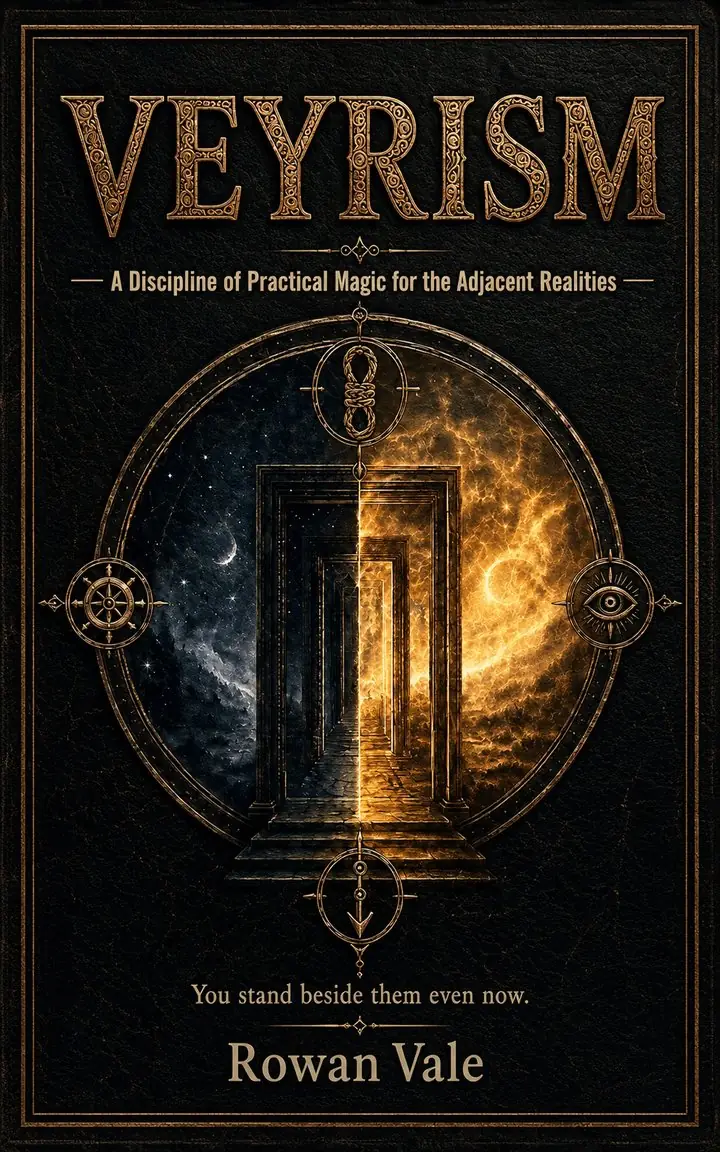
Veyrism
by Rowan Vale
You stand, at every moment of your life, beside a boundary you cannot see. On your side of it is the world as it is. On the other side, pressed close enough to touch, are the worlds as they could be. The boundary is called the Veyr.
This book is a complete practice built on that boundary: a discipline of attention, a calendar of observance, a vocabulary precise enough to think with, and a single instrument of record, the Chartbook. It opens with a working, not an explanation, because practice comes before theory in Veyrism. It will not tell you what the Veyr is. Not in the first chapter, not in the last one, not anywhere.
In this book, magic is a word for a way of practicing attention. Nothing in these pages claims supernatural ability, paranormal power, or control over events, other people, or the world beyond oneself.
Inside
What the book holds
- The First WendA working before an explanation: a doorway, a few minutes, a pen.
- Part One · The BoundaryYou stand beside it now. The weir. The adjacent realities. The thin.
- Part Two · The WorkThe Wend. The Call. The Chartbook. The three endings. The six instruments.
- Part Three · The Four PathsThe Watcher, the Will, the Wayfarer, the Bound.
- Part Four · The YearAurora, Meridian, Hesper, and Penumbra, the crown of the year.
- Part Five · The OthersWending where two stand. Circles, Keepers, Wardens. The practitioners.
- The ClosingThe gate.
- AppendicesThe lexicon. The year at a glance. A Chartbook page.
From the Book
The Founder's Page
I was born in the eleventh hour of the Penumbra, in a prime year, though it would be decades before I knew what hour that was or what to call it. The night knew. Nights generally do.
I have traveled through many thresholds since. Doorways, state lines, the last days of old lives and the first days of new ones. I have learned much. I have lost more. My Chartbook does not flatter me, and I would not trust it if it did.
I did not invent the Veyr. I noticed it, the way you notice a draft in a house you have lived in for years, and then cannot stop noticing it. Everything in this book follows from that noticing.
This tradition is new. There are no elders behind these pages, no circles yet, no centuries of practice to lean on. This craft begins in the open, dated, like everything else it will ask you to write. I would rather found a small true thing than a large invented one.
R.V.
An Honest Accounting
This book asks you to chart what happens and to conclude slowly. The same courtesy is asked of a review. An honest accounting of the book, wherever you bought it, is worth more to a small true thing than praise. Chart it level.